
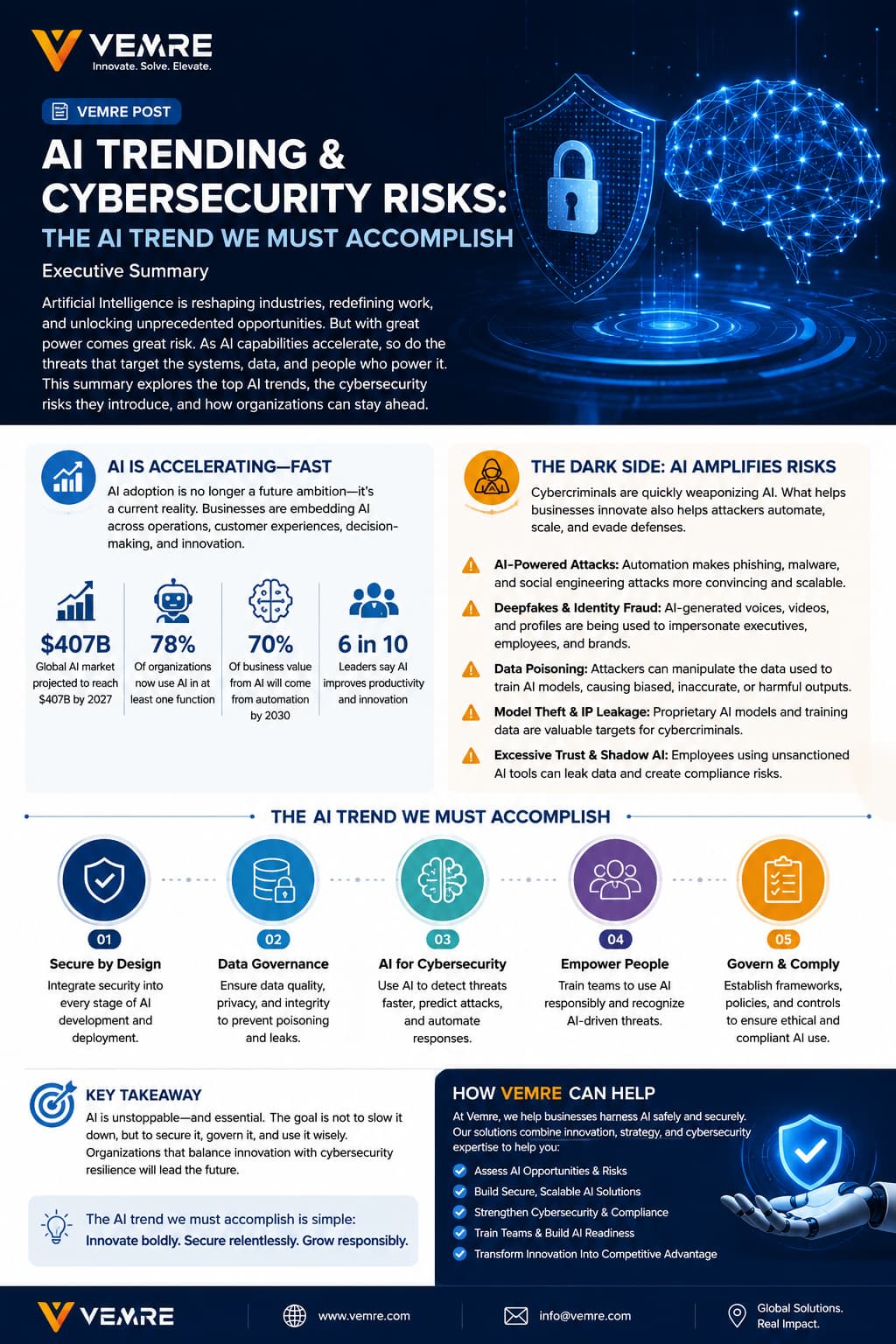
Organizations across industries are using AI to automate repetitive work, analyze information, improve customer experiences, generate content, support decision-making, develop software, and accelerate innovation. At the same time, AI is rapidly changing the cybersecurity threat landscape.
The opportunity is enormous but so is the responsibility.
As organizations move from experimenting with AI chatbots to deploying AI agents capable of interacting with business systems and taking actions, cybersecurity can no longer be treated as an afterthought. NIST notes that AI agents introduce novel security challenges because model outputs can be combined with software functionality and autonomous actions.
The question for businesses is therefore no longer:
"Should we use AI?"
The better question is:
"How do we use AI aggressively enough to remain competitive while securing it responsibly?"
AI Is Accelerating Fast
AI adoption is moving from isolated experimentation into everyday business operations.
Organizations are using AI for:
Customer service
Marketing
Software development
Data analysis
Cybersecurity
Financial analysis
Human resources
Content creation
Research
Business intelligence
Workflow automation
Decision support
The emergence of AI agents represents an even bigger shift. Unlike traditional chatbots that primarily respond to prompts, agents can potentially plan tasks, interact with applications, call tools, retrieve information, and execute actions.
That creates tremendous productivity opportunities—but also expands the attack surface.
NIST's 2026 work on AI-agent security highlights that organizations will need to adapt traditional cybersecurity practices to address these new risks.
The Dark Side: AI Is Also Amplifying Cybersecurity Risks
The same technology that helps an organization operate more efficiently can help an attacker operate more efficiently.
Cybercriminals can use AI to make attacks more convincing, personalized, scalable and adaptable.
NIST's Cyber AI Profile identifies AI-enabled spear-phishing, deepfake-based manipulation, hyper-realistic malicious websites and AI-assisted malware development among emerging concerns.
1. AI Powered Phishing and Social Engineering
Traditional phishing often contains obvious spelling mistakes, generic messages or suspicious formatting.
AI can dramatically improve the quality of malicious communications.
Attackers can generate highly personalized messages that imitate:
Executives
Vendors
Employees
Customers
Recruiters
Financial institutions
IT personnel
AI can also help attackers research targets and construct believable narratives.
This means employees can no longer rely solely on "Does this email look professional?" as a security test.
Organizations need stronger identity verification, authentication, email security, employee awareness and transaction-verification procedures.
2. Deepfakes and Identity Fraud
Voice cloning and synthetic video are creating a new dimension of social engineering.
Imagine receiving a video call appearing to be your CEO asking you to approve a payment.
Or receiving an audio message that sounds exactly like your manager.
The technology makes impersonation significantly more convincing.
NIST's Cyber AI work specifically highlights audio and video manipulation—including deepfakes—as an emerging component of AI-enabled spear-phishing.
The lesson: organizations need verification procedures that don't depend entirely on someone's voice, face or apparent identity.
3. Prompt Injection
One of the most important emerging AI security risks is prompt injection.
A prompt injection occurs when malicious instructions are inserted into content an AI system processes, potentially causing the system to disregard its intended instructions or perform an unintended action.
This becomes particularly serious when an AI agent has access to:
Email
Files
Databases
APIs
Financial systems
Customer information
Internal applications
Microsoft describes prompt injection against agents as malicious instructions embedded in content that an AI agent reads and potentially acts upon.
The danger increases when AI moves from answering questions to taking actions.
4. Shadow AI
Employees are increasingly adopting AI tools independently.
They may use AI applications to:
Summarize confidential documents
Analyze spreadsheets
Rewrite customer communications
Review contracts
Generate software code
Analyze company data
The problem is not necessarily the use of AI.
The problem is uncontrolled AI use without organizational visibility or governance.
Google Cloud's 2026 AI risk analysis identifies "Shadow AI" and limited visibility into AI assets as important organizational risk areas.
Organizations should know:
What AI tools are being used?
Who is using them?
What information is being entered?
Where is that information going?
What permissions does the AI have?
5. Data Leakage and Privacy
AI systems are only as secure as the information surrounding them.
Employees may unintentionally expose:
Personally identifiable information
Customer records
Financial information
Intellectual property
Source code
Business strategies
Credentials
Confidential contracts
Organizations therefore need clear policies governing what information may—and may not—be entered into AI systems.
Data classification, access control, encryption, DLP, vendor risk management and monitoring remain fundamental.
6. Data Poisoning and AI Manipulation
AI systems depend heavily on data.
If attackers manipulate training data, retrieval sources or other information used by an AI system, they can potentially influence the system's outputs.
NIST identifies data poisoning, model extraction, inference attacks and insecure AI/ML pipelines among the broader AI security landscape.
This creates a critical principle:
AI security is also data security.
7. AI Doesn't Eliminate Traditional Cybersecurity
There is a temptation to think AI security replaces traditional cybersecurity.
It doesn't.
Organizations still need:
Strong identity and access management
Multi-factor authentication
Vulnerability management
Endpoint security
Network security
Encryption
Secure software development
Backup and recovery
Incident response
Security awareness
Continuous monitoring
NIST emphasizes that many AI security risks overlap with established cybersecurity concerns involving confidentiality, integrity and availability.
AI adds another layer to the cybersecurity equation—it doesn't eliminate the foundation.
The AI Trend We Must Accomplish
The goal should not be to slow down AI adoption.
The goal should be responsible acceleration.
Organizations that successfully adopt AI will be those that combine innovation with governance, security and accountability.
01. Secure by Design
Security should be considered before an AI system is deployed—not after an incident.
Organizations should evaluate:
Architecture
Access controls
Data flows
APIs
AI models
Third-party vendors
Agent permissions
Monitoring
Incident response
02. Establish AI Data Governance
Organizations need clear rules around:
What data AI can access
What employees can upload
Where data is stored
Who can access AI systems
How long information is retained
How vendors handle organizational data
03. Use AI to Fight AI
AI should not only be viewed as a threat.
It can also strengthen cybersecurity.
Organizations can use AI to support:
Threat detection
Security monitoring
Incident triage
Vulnerability analysis
Security operations
Fraud detection
Anomaly detection
Threat intelligence
NIST's Cyber AI Profile specifically recognizes opportunities to use AI to enhance cyber defense while addressing the risks created by AI-enabled attacks.
04. Empower Employees
Technology cannot compensate for an organization that has poorly trained users.
Employees need practical training on:
AI acceptable use
Phishing
Deepfakes
Social engineering
Data protection
Password security
MFA
AI-generated misinformation
Suspicious AI-generated communications
The human being remains an important part of the security architecture.
05. Govern and Continuously Monitor
AI security cannot be a one-time project.
NIST has emphasized the importance of post-deployment monitoring because AI systems can behave differently in real-world environments and require ongoing evaluation.
Organizations should continuously:
Assess → Monitor → Test → Detect → Respond → Improve
NIST's 2026 research also underscores that fixed AI guardrails cannot be assumed to be universally robust against adaptive adversarial prompts.
What Businesses Should Do Now
Every organization adopting AI should consider conducting an AI Security & Governance Assessment.
At minimum, ask:
What AI systems are we currently using?
Who has access to them?
What company data can they access?
Are employees using unauthorized AI tools?
Are AI agents connected to business systems?
Can an AI system execute actions without human approval?
How are AI-generated decisions reviewed?
What happens if an AI system is compromised?
Do our cybersecurity policies address AI?
Have our employees been trained on AI-enabled threats?
If the answers aren't clear, there may already be an AI governance gap.
The Executive Takeaway
AI is going to change how businesses operate.
Organizations that ignore it risk falling behind.
Organizations that adopt it without security and governance risk exposing themselves to new vulnerabilities.
The winners will be organizations that do both:
Innovate aggressively.
Secure relentlessly.
Govern responsibly.
AI should not be treated as simply another software application.
It is becoming an operational capability that can influence people, data, applications and business decisions.
That means cybersecurity leadership must evolve alongside AI adoption.
How Vemre Can Help
At Vemre, we believe technology should create opportunity not unnecessary risk.
Our technology, cybersecurity, digital transformation and business consulting capabilities can help organizations evaluate where AI can create value while identifying the security, governance and operational risks that come with adoption.
Vemre can support organizations with:
AI & Technology Strategy
Cybersecurity Assessments
IT & Technology Consulting
Risk & Compliance Advisory
Digital Transformation
Security Awareness & Training
Business Process Improvement
AI Adoption & Governance
Technology Strategy
The future belongs to organizations that can move quickly without losing control of their security.
The AI trend we must accomplish is not simply adopting AI.
It is adopting AI securely, strategically and responsibly.
Comments
Be the first to comment.
Leave a Comment